
Drain Field Problems in the Flathead Valley
Soggy ground, odors, or slow drains even after pumping usually point to the drain field. Here's how it's diagnosed and what it costs.
- Diagnosis before any digging
- Repair options before replacement
- Help with county permits
Get a free quote
Tell us what's going on. You'll get a call or text back with a price and the next opening.
What the drain field does
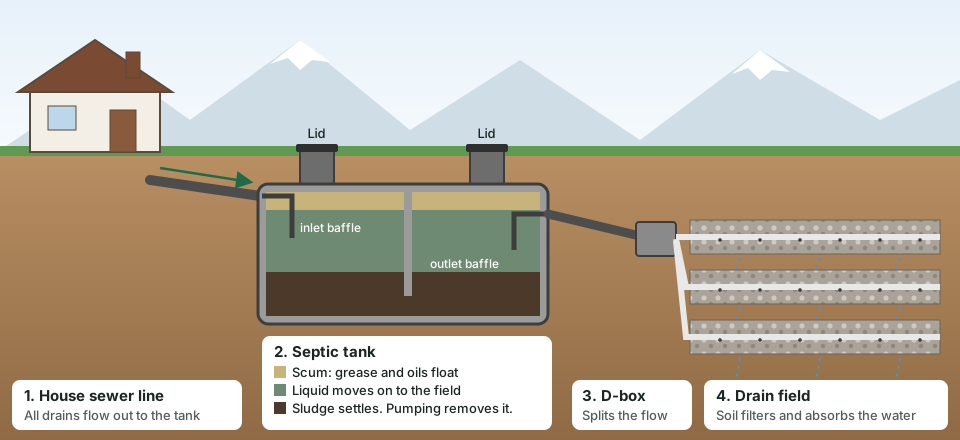
After the tank separates out the solids, the liquid flows to the drain field: perforated pipes in gravel trenches, or chambers, buried in your yard. The soil underneath filters and absorbs it.
A drain field fails when the soil can't absorb water fast enough. The usual cause is solids that escaped the tank because it wasn't pumped, or because a baffle failed. Over time those solids form a mat that seals the soil.
Warning signs
Wet or spongy ground
Over the field, especially when it hasn't rained.
Bright green stripes
Grass greener over the trenches than the rest of the yard.
Odor in the yard
A sewage smell near the field after showers or laundry.
Backups after pumping
If drains slow down again soon after a pump-out, the field likely isn't accepting water.
How it's diagnosed
The first step is pumping the tank and checking the baffles and outlet, because a cheap fix there sometimes solves the problem. Next comes the distribution box, the lines (often with a camera), and probing the trenches to see where water is standing.
Repair options
Rest and reduce. A stressed field sometimes recovers if water use drops and the tank is pumped. Fixing leaky toilets and spreading out laundry helps more than people expect.
Fix the cause. Replacing a broken baffle, adding an effluent filter, or leveling the distribution box stops more solids from reaching the field.
Jetting the laterals. Cleaning the perforated pipes can restore flow when the problem is in the pipes rather than the soil.
Replacement. When the soil is sealed, the field needs to be rebuilt or relocated. Costs vary widely, from about $3,000 for a small conventional field to $20,000 or more for systems that need a pressure-dosed or engineered design.
Permits
Drain field replacement in Flathead County requires a permit from the county health department, and some sites need a site evaluation first. Lakefront and high-groundwater lots often need a different system design. The contractor handles the paperwork as part of the job.
Worried about your drain field?
Start with a pump-out and inspection. It's the cheapest way to find out what's going on.